


Reference: 1232



Skullcap, also known as scullcap, is a small perennial, herbaceous plant from the Lamiaceae family. It is highly branched and measures about 30 cm in height. This variety originates from Canada in North America. Its growth cycle is very fast, starting to grow in May and ending its cycle around September.
The leaves are opposite, lanceolate in shape, with edges that can be smooth or slightly toothed. Their texture is embossed. The color varies from a light green to a darker green, creating a dense carpet on square-shaped stems.
Its flowers are distinguished by their characteristic helmet shape, with a curved upper lip protecting the reproductive organs. They are grouped in terminal spikes and often display blue or even purple hues. Flowering takes place throughout the summer until autumn.
After fertilization, the flower gives way to a small protective receptacle that resembles a little shield. This dry fruit contains four small seeds released when the capsule reaches full maturity.
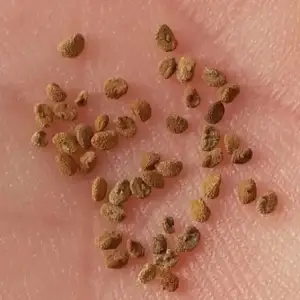
Skullcap seeds from Scutellaria lateriflora are yellow, rough, and small, measuring 2 millimeters in length.
Shady Area Cultivation and Biodiversity Support
Perfect for borders or containers located in semi-shaded areas, Skullcap is a valuable ally for ecological gardens.
Its nectar-rich blooms actively attract bees and bumblebees, offering a high-quality food resource while structuring your green spaces with a natural, wild elegance.
The Miniature Helmet of Garden Knights
Skullcap owes its botanical name (Scutellaria) to the Latin scutella, which means "little cup" or "dish".
Look closely at its flowers: their unique shape perfectly mimics a small medieval protective helmet or a raised visor.
A graphic feat of nature that gives this plant immense charm in borders or rock gardens.
Scutellaria thrives in cool soil, rich in organic matter, and above all very well-drained to avoid stagnant moisture. A mixture of 70% garden soil, 20% compost, and 10% sand suits it perfectly.
A semi-shaded position is ideal to encourage abundant and colorful flowering. It appreciates filtered light during the hottest hours of the afternoon, especially in dry climates.
This perennial is very hardy and withstands heavy winter frosts (-15°C) once established. It is more sensitive to sudden temperature variations combined with overly waterlogged soil in winter.
Watering should be regular throughout the growth period to keep the soil slightly moist without ever saturating it. Mulching at the base helps maintain the essential coolness for foliage development during intense summer heat.
This article was written by Julien on 07/15/2026.
Your review appreciation cannot be sent
Report comment
Report sent
Your report cannot be sent
Write your review
Review sent
Your review cannot be sent

check_circle
check_circle


