


€3.99
Reference: 1232


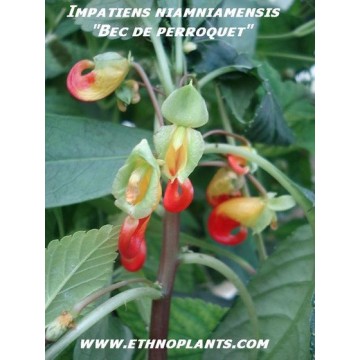
PARROT IMPATIENS, 10 - 20 cm tall
Zanzibar Impatiens, Zaire Impatiens, or Congo cockatoo, also known as Niam-niam or Parrot Impatiens, is a stunning, fast-growing perennial native to the tropical forests of the Congo in Africa. It belongs to the Balsaminaceae family and typically reaches 40 to 80 cm in height. It is undoubtedly one of nature's most whimsical creations.
Its flowers are distinguished by their vibrant colors, ranging from red to yellow. They possess a singular shape resembling the beak of an exotic bird and grow in clusters along the stems, creating a beautiful visual effect, especially during full bloom.
The evergreen, glossy leaves are generally oval or oblong with a shiny texture. They have slightly wavy, often serrated edges. The foliage is a bright green, providing a lovely contrast to the colorful flowers.
Parrot cockatoo seeds are small, round, and black, measuring only one to two millimeters in diameter. They must be sown quickly after harvest in a moist mixture of potting soil and peat and placed in a location with a temperature of 27°C.
A Botanical Oddity: The "Parrot Beak"
Impatiens niamniamensis is a natural curiosity that leaves no one indifferent. Originating from the undergrowth of Central Africa, it stands out for its extraordinary flowers shaped like curved horns, boasting a vibrant gradient of scarlet red and bright yellow.
This graphic silhouette faithfully resembles a parrot's beak, making this plant a true living sculpture for your home.
Generous and Continuous Blooming
Unlike classic garden impatiens, this exotic variety is a blooming marathon runner. When grown indoors, in a conservatory, or in a bright bathroom, it offers a nearly uninterrupted colourful spectacle throughout the year.
With its fleshy stems and glossy green foliage, it brings a touch of sophisticated tropical jungle, perfect for modern interiors.
The Queen of Shady Corners
If you are looking to green up semi-shaded areas, this Impatiens is the ideal candidate.
Disliking direct sunlight, which could scorch its tissues, it thrives in soft light and a temperate atmosphere.
Its rapid growth and elegant silhouette make it an ultra-rewarding collector's subject, capable of brightening up even the most intimate spaces in the house.
Use well-draining soil; ideally, a mix based on peat potting soil with perlite or vermiculite to improve aeration. A slightly acidic to neutral pH is favorable.
Its preferred exposure is bright but indirect light. An east- or west-facing window is generally the ideal location.
It thrives in ambient temperatures between 18°C and 30°C. It can tolerate slightly lower temperatures, but growth will slow down. It is a non-hardy plant that must be brought indoors for the winter. Its USDA zone is 10a.
Water regularly to keep the soil moist but never waterlogged. Allow the top of the soil to dry slightly between waterings. In winter, generally reduce watering frequency to once a week as the plant enters a less active phase.
The most common way to multiply it is through cuttings. Take healthy stem cuttings 10 to 15 cm long, ensuring they have at least 2–3 nodes, and plant them in a light, well-drained mix or place them in water until roots develop. Reproduction by seed is also possible.
Occasionally (though rare indoors), the leaves may be attacked by a fungal disease called powdery mildew, appearing as a white powder. Root rot occurs in cases of excessive moisture and poor drainage.
During the growing season (spring and summer), apply a flowering plant fertilizer every 2 to 4 weeks. Prune the stems just above a node to encourage branching and to shorten stems that have grown too long.
This article was written by Julien on 07/16/2026.
Your review appreciation cannot be sent
Report comment
Report sent
Your report cannot be sent
Write your review
Review sent
Your review cannot be sent

check_circle
check_circle


