


- Out-of-Stock

Reference: 1232



Chilean Black Creeper or Zabala is a tropical climbing plant belonging to the Lardizabalaceae family.
It is an extremely rare, fast-growing perennial that can reach 10 meters in height. It is native to South America, primarily Chile and Peru.
The foliage is evergreen and stands out due to a complex structure called biternate, meaning each leaf is divided into three leaflets, which are themselves subdivided into three.
The leaflets are leathery, dark green, and glossy on top, with an oval shape and sometimes slightly serrated edges.
The flowering is dioecious, bearing male and female flowers on separate plants. The male flowers are the most spectacular, gathered in hanging clusters. They display a dark purple, almost chocolate color, with fleshy petals surrounding prominent stamens.
Its fruits are fleshy, elongated berries resembling small sausages, measuring about 5 to 8 cm long. Their skin is initially green, turning bluish-purple or grayish at full maturity. They are edible and have a mild, sweet pulp, highly prized in local markets in Chile, where they are known as "coyul."
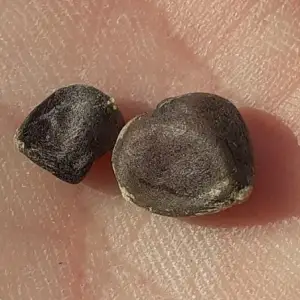
Black creeper seeds, from the Lardizabala biternata, are numerous, measuring 6 to 8 millimeters in length with an average weight of 15 centigrams. They are ovoid in shape and have a fairly hard texture.
This vine appreciates rich, deep, and above all, very well-drained soil to flourish properly. A mix of 50% fertile garden soil, 25% leaf mold, and 25% well-decomposed compost constitutes an ideal base. Although it tolerates varied soils, it shows a marked preference for slightly acidic substrates.
The ideal exposure is in partial shade, particularly in regions where the afternoon sun can prove scorching for its evergreen foliage. It likes having "cool feet and a warm head" (roots in the shade, foliage in the light), a configuration often found in its original forest habitat. A position against an east or west-facing wall suits it perfectly.
The hardiness of this plant is moderate, as it can withstand brief frosts down to approximately -7°C or -10°C under optimal conditions. It prefers oceanic or mild temperate climates where winters are not too severe. In areas with cold winters, it is strongly advised to plant it in a spot sheltered from prevailing winds or to protect the base with a thick layer of organic mulch.
Watering must be regular during the growth period and at the time of planting. It is important to maintain some coolness at the base of the plant without waterlogging the soil. Once well-established, it can tolerate short periods of drought.
Propagation is traditionally carried out by seed or by semi-ripe stem cuttings in late summer. Layering is a very effective and often simpler method, involving burying a flexible stem so that it produces roots before being separated from the mother plant.
The shrub is robust and not very prone to massive pest attacks or serious diseases. However, it may occasionally be visited by aphids on young spring shoots.
Your review appreciation cannot be sent
Report comment
Report sent
Your report cannot be sent
Write your review
Review sent
Your review cannot be sent
Reference: 0136
Reference: 1175

check_circle
check_circle


