


€3.99
Reference: 1232


Tree Sensitive Plant, scientifically known as Mimosa quadrivalvis, is a shrub in the Fabaceae family that grows between 1 and 2 meters in height. It is an annual or short-lived perennial variety. The plant is native to North America, Central America, and the Caribbean. It grows on forest edges as well as in damp meadows.
The stems are the most remarkable feature of this plant. They have a distinctly quadrangular (square) cross-section with four well-marked protruding angles. They are woody at the base and bear small hooked spines along the ridges.
The foliage consists of alternate, bipinnate, and very finely divided leaves. Each leaf, measuring about 10 cm in length, is divided into several pairs of pinnae, which are themselves composed of numerous small, crowded oblong leaflets. Like many mimosas, the leaflets exhibit tactile or nyctinastic sensitivity, folding slightly inward when touched or in darkness.
The flowers are clustered in small inflorescences, forming creamy white or very pale pink pom-poms. These spherical heads are supported by thin stalks (peduncles) emerging from the leaf axils. The fruit is a flat, elongated pod. Its uniqueness lies in its structure, which is bordered by bristles or small prickles on the margins.
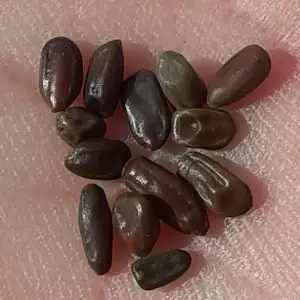
Tree Sensitive seeds are oval and brown with a hard, shiny seed coat of brown or blackish color. Their extreme hardness allows them to maintain their germinative power in the soil for a long period.
A Marvel of Thigmonasty
Mimosa quadrivalvis is a fascinating species with thorny stems and foliage capable of thigmonasty, delicately folding upon touch.
Originating from wild regions, this collector's plant offers an immersive botanical experience, illustrating some of the most sophisticated plant defence mechanisms in the natural world.
A Floral Spectacle for Biodiversity
Its vibrant pink to purple pom-pom blooms provide a dazzling visual spectacle that irresistibly attracts bees and butterflies throughout the season.
Beyond its ornamental appeal, this specimen helps enrich the soil through its natural nitrogen-fixing ability, enhancing the vitality of your garden.
A Plant of Character for Sunny Gardens
Ideal for warm rock gardens or naturalistic landscapes, this mimosa requires a bright location and well-drained soil to express its full vigour.
Cultivated exclusively for the joy of observation and biodiversity preservation, this plant should be handled gently to preserve its foliage.
This plant prefers light, well-drained, and rather sandy or stony soil. It adapts to poor soils but appreciates the presence of well-decomposed organic matter. For pots, a mixture of 80% leaf mold and 20% river sand is ideal.
Mimosa quadrivalvis requires full sun exposure so that its stems can stiffen and its flowering remains abundant. Insufficient light leads to excessive stretching of the stems (etiolation) and weakens the quadrangular ridges.
It is a tropical and subtropical plant that generally does not support frost. While it can tolerate brief dips, its hardiness is limited; the plant shows signs of stress as soon as temperatures drop below 10°C. In temperate zones, it should be overwintered in a warm greenhouse or a bright interior.
Watering should be regular during the growing season, ensuring that the substrate dries slightly on the surface between waterings. Although it can tolerate brief periods of drought once established, a prolonged lack of water causes yellowing and dropping of the leaflets. In winter, watering should be drastically reduced.
The most common method is sowing in spring. Cuttings of semi-hardwood stems are possible in summer under a cloche or in a humid atmosphere, although the success rate is more hit-or-miss.
It can be subject to aphid attacks on young, tender shoots and mealybugs, which often lodge in the leaf axils or along the angular stems. Excess humidity, especially during the resting period, can encourage the development of root fungi.
This article was written by Julien on 07/16/2026.
Your review appreciation cannot be sent
Report comment
Report sent
Your report cannot be sent
Write your review
Review sent
Your review cannot be sent
Reference: 0334

check_circle
check_circle


