


Reference: 1232



Black Hollyhock, also known by its Latin name Alcea rosea nigra, is a very hardy biennial plant native to Southwest China. It reaches a height of 1.5 to 2 meters and belongs to the Malvaceae family.
The black flowers of the Alcea nigra are single-petaled and measure 5 to 10 cm in diameter. They are highly decorative in gardens, especially when planted against a light-colored wall. These spectacular flowers bloom from July until the beginning of September. While they are odorless, they attract many pollinating insects.
The whorl-shaped fruits appear at the end of the summer season. Each contains approximately 20 to 30 seeds.
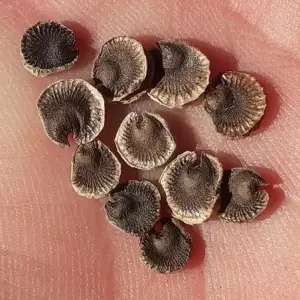
Black hollyhock seeds are dark brown, circular, flat, and measure an average of 5 millimeters in diameter, weighing only a few decigrams.
Its foliage is deciduous, thick, and green, with lobed leaves arranged alternately.
A Dark and Vertical Elegance
Introducing Ethnoplants seeds to your garden allows you to grow the famous black hollyhock, whose deep purple flowers bordering on ebony beautifully structure flowerbeds.
This imposing stature, typical of cottage gardens, offers a prolonged summer flowering that irresistibly attracts pollinators, turning every border into a dramatic, living picture of rare chromatic intensity.
A Dyeing Treasure for Natural Colorants
Beyond its aesthetics, this variety grown from reproducible seeds is a valuable resource for craftsmanship, as its petals are naturally saturated with anthocyanins.
These plant pigments make it possible to create inks or dye textiles in shades ranging from mysterious violet to intense black, offering an eco-friendly and biodegradable alternative.
For container gardening, ensure good drainage at the bottom with gravel, small stones, or clay pebbles. It requires an airy, well-draining substrate rich in humus and organic matter.
This plant requires a lot of water during its growth phase and especially during flowering. However, never drown the plant, as root rot is a frequent risk. One watering per week is recommended for plants in the ground, and every 3 days for those in pots. Mulching at the base of the plant will help reduce the frequency of watering.
The dark-flowered hollyhock must be exposed to full sun to bloom abundantly. For indoor cultivation under artificial light, horticultural LEDs or MH (Metal Halide) bulbs are preferred.
This hardy plant grows well in temperatures ranging from 10°C to 25°C. It is very robust and can easily withstand extreme freezing temperatures as low as -18°C. Its USDA hardiness zone is 2-9.
The only way to reproduce this tall, beautiful plant is through sowing; unfortunately, it cannot be grown from cuttings.
It is sometimes infested by caterpillars that devour the leaves, leading to severe defoliation. The foliage is also frequently attacked by rust; in this case, a treatment with Bordeaux mixture (copper sulfate and lime) is necessary.
This article was written by Julien on 07/15/2026.
Your review appreciation cannot be sent
Report comment
Report sent
Your report cannot be sent
Write your review
Review sent
Your review cannot be sent

check_circle
check_circle


