


Reference: 1232



Lion's Tail, also known as Wild Dagga or Leonotis leonorus, is a fast-growing perennial from the Lamiaceae family.
It is a beautiful variety that grows in the African savannah. It reaches 1.50 meters in height, and its lifespan is generally 4 to 5 years.
Its evergreen leaves are narrow, lanceolate, and measure 5 to 12 centimeters. They display a dark green hue on the upper side with sharply toothed edges reminiscent of mint. Their opposite arrangement along the woody stems releases a powerful aromatic scent when lightly crushed between the fingers.
The flowering is distinguished by globular whorls (verticils) stacked along tall, upright floral spikes. These velvety, tubular flowers boast a brilliant orange color that evokes the texture and hue of a lion's fur. They produce abundant nectar that irresistibly attracts pollinators throughout the summer and until late autumn.
After the corollas fall, the persistent calyxes harden and become prickly, protecting the developing seeds inside. The fruits are achenes clustered at the bottom of these dry cells, which take on the appearance of geometric honeycombs.
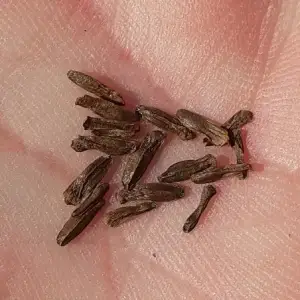
Lion's Tail seeds are brown, wide, and flattened, measuring 6 millimeters in length.
The Flamboyant Beacon of African Lands
Originating from South Africa, the Lion's Tail (Leonotis leonurus) owes its name to its spectacular crowns of hairy flowers that resemble the lion's mane.
Introducing this exotic variety into your flowerbeds ensures a stunning vertical orange blaze that will capture every gaze from summer until the first frost of autumn.
The Five-Star Palace for Pollinators
In its natural habitat, the unique tubular shape of this plant is perfectly adapted to nectar-feeding birds.
In our latitudes, butterflies and bumblebees will flock to this incredible honey plant, turning your green space into a permanent and fascinating aerial ballet of energy.
The Giant Asset for Sun-Drenched Gardens
If you are looking for a variety capable of withstanding heatwaves without flinching, this shrub from the sage family is the ideal candidate for a low-water garden.
Easily started from seeds, Leonotis leonurus thrives at a surprising speed in full sun, offering a powerful graphic structure that breaks the monotony of traditional bushes.
It thrives in light, stony, and perfectly drained soil to avoid root suffocation. It tolerates poor or limestone soils very well, typical of Mediterranean-style gardens.
Full sun exposure is essential to ensure vigorous growth and brilliant flowering. Direct heat also promotes nectar production and the intensity of the flowers' orange color.
Native to South Africa, it enjoys warm climates (25 - 35°C) and only tolerates brief frosts down to about -3 degrees. In cold regions, pot cultivation allows it to be sheltered during the winter period.
Its water needs are moderate as it has excellent drought tolerance once established. Weekly watering is sufficient during the summer, while it should be almost stopped during winter dormancy.
Propagation is easily achieved by seed or by semi-ripe stem cuttings in late summer. Dividing clumps at the restart of vegetation is also an effective propagation technique.
This article was written by Julien on 07/14/2026.
Your review appreciation cannot be sent
Report comment
Report sent
Your report cannot be sent
Write your review
Review sent
Your review cannot be sent

check_circle
check_circle


