


Reference: 1232



Leadplant, also known as False Indigo or Amorpha canescens in Latin, is a perennial plant belonging to the Fabaceae family. It is native to North America, thriving from southern Canada to northern Mexico. This relatively rare, fast-growing shrub is quite hardy and grows very well in temperate climates. At maturity, it generally reaches a height of 1 to 3 meters.
Its leaves are compound and alternate. They are typically pinnate, with 9 to 15 narrow, elongated leaflets measuring about 2 to 7 cm long. They are often pubescent, giving them a slightly hairy texture and a grey-green color. The leaves tend to cluster at the top of the stem, creating a bushy appearance.
The flowers appear in terminal clusters and are purple in color. Each flower is composed of five petals, including a larger upper petal shaped like a sail and two smaller lateral petals. The flowering period takes place in summer, from June to August.
Its fruits are pods that form after pollination. These pods are flat, elongated, and measure about 3 to 5 cm in length.
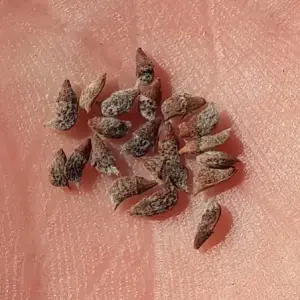
Leadplant seeds are small, light, and light brown in color with a faint white down. They have an unusual shape resembling a tiny mouse.
It grows in well-drained soil, often sandy or loamy. It tolerates nutrient-poor soils, making it an ideal plant for prairies and dry areas.
This dye plant loves full sun exposure. It requires at least 6 to 8 hours of light per day to thrive properly. Full sun exposure promotes its growth and, above all, its beautiful flowering.
It is quite hardy and can tolerate a wide range of temperatures, varying from -15°C to 35°C. It is well-adapted to drought conditions, making it ideal for arid gardens or regions with low rainfall.
Once established, this bush is relatively drought-resistant and requires little watering. During the first year, regular watering every two days is recommended to help establish its root system.
Its primary means of reproduction is by seed, but it can also be propagated by stem cuttings in late spring and early summer.
Your review appreciation cannot be sent
Report comment
Report sent
Your report cannot be sent
Write your review
Review sent
Your review cannot be sent
Reference: 0140

check_circle
check_circle


