


Reference: 1232



Black Nightshade, also known as Devil's Tomato, is a European herbaceous plant from the Solanaceae family. It is an annual variety that grows rapidly, reaching about 60 cm in height.
The flowers are white, grouped in clusters at the leaf axils, and consist of five star-shaped petals. They have a delicate appearance and measure 1 cm in diameter. Flowering occurs from summer until early autumn.
Its fruits are round, black, and shiny berries measuring approximately 1 to 2 cm in diameter. They are toxic when they are not ripe.
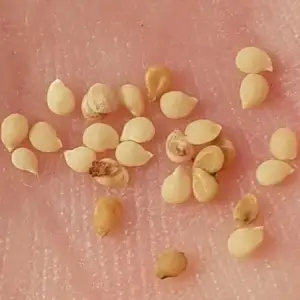
Black nightshade seeds from Solanum nigrum are yellow, circular, and small, measuring 2 to 3 millimeters in diameter.
A Witness to Biodiversity
The Black Nightshade is a fascinating species sharing a botanical kinship with iconic crops such as the tomato and the eggplant.
As a pioneer plant par excellence, it is recognized by botanists for its natural ability to colonize tilled or bare soil.
It is an ideal subject for studying the mechanisms of resilience and the rapid development of wild species.
A Subject of Ethnobotanical Interest
Sometimes nicknamed "wolf grape," Black Nightshade holds a special place in ancient herbals and the narratives of traditional European botany.
It is a plant that has long accompanied human history, being the subject of numerous observations in classical phytology works.
Today, it remains an essential specimen for any collector wishing to build a botanical collection representative of the companion species of our regions.
It grows very well in soils rich in organic matter and well-drained. It can tolerate poor and dry soils, but its growth will be reduced.
This rather robust esoteric plant prefers a very sunny exposure, but it can also tolerate partial shade. A full-sun location will promote better development and a more abundant fruit production.
It thrives in temperatures ranging from 15 to 25°C. It is frost-sensitive and dies if temperatures drop below freezing.
This "witchcraft" nightshade requires regular watering, especially during dry summer periods. However, it is important to avoid excess water, as this can lead to root rot. It is advisable to water when the soil begins to dry on the surface.
The easiest way to reproduce the Devil's Tomato is by sowing its seeds.
Thoroughly remove all dry parts at the end of autumn.
This article was written by Julien on 07/11/2026.
Your review appreciation cannot be sent
Report comment
Report sent
Your report cannot be sent
Write your review
Review sent
Your review cannot be sent

check_circle
check_circle


