€3.99
Reference: 1232


Adusa, also known as Vasaka or Malabar Nut, is a herbaceous plant belonging to the Acanthaceae family.
It is a small semi-tropical tree native to India and Asia, typically reaching 2 to 3 meters in height. Its growth is rapid, and it features evergreen foliage.
The stems are thick and cylindrical, varying from light to dark green depending on their age, and are often covered with fine hairs.
The leaves are lanceolate, long, and pointed with entire margins. Their surface is smooth with a glossy dark green color.
They are arranged oppositely on the stem with short petioles and have a leathery texture.
The flowers are tubular, white or cream-colored, and often feature pale violet shades at the base.
They cluster in panicle inflorescences and emit a subtle fragrance. Flowering primarily occurs from summer through late autumn.
Fruits are oval capsules that turn brown or black upon maturity, at which point they split into several parts.
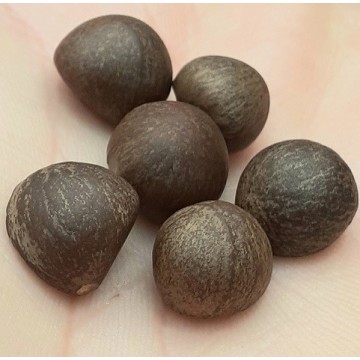
Vasaka seeds from Justicia adhatoda are brown, round, and very robust. They grow inside the fruits commonly referred to as Malabar nuts.
Historical Heritage
The Vasaka possesses a traditional usage that spans the ages.
Present for centuries in ancient botanical writings, it holds a privileged place in Asian ethnobotanical heritage, where it has long captured the interest of nature observers for its customary uses and role in local culture.
Rare Aesthetics
Beyond its historical interest, Vasaka is a top-tier ornamental plant.
It is particularly admired for its spectacular flowering: delicate white flowers, finely streaked with purple, offering a striking visual contrast that makes this shrub a centerpiece for any demanding plant collection.
Collector’s Choice
Growing this specimen from Ethnoplants means preserving a plant with deep cultural roots.
Reserved for ornamental purposes and the safeguarding of biodiversity, this exceptional plant enriches your garden with a noble and mysterious presence.
For ornamental and ethnobotanical use only; do not consume.
Adusa thrives in a well-drained, light, and fertile substrate. A mix of universal potting soil with a bit of perlite will promote healthy growth.
It enjoys full sun. Sunny exposure allows it to fully develop its leaves and flowers.
Native to warm climates, it tolerates temperatures down to 5°C but prefers a range between 20°C and 30°C.
It has low hardiness and must be protected from frost with heavy mulching at the base and winter fleece for the upper parts.
It requires moderate watering, allowing the soil surface to dry out between applications.
During the growth period and immediately after planting, regular watering is recommended, but without excess.
Multiplication is mainly achieved through semi-mature stem cuttings in summer or by seeds.
Stem cuttings are the fastest and most effective method for reproduction.
It can be attacked by mealybugs or spider mites. A treatment based on natural insecticides or soapy water is effective in controlling these pests.
This article was written by Julien on 07/20/2026.
Your review appreciation cannot be sent
Report comment
Report sent
Your report cannot be sent
Write your review
Review sent
Your review cannot be sent
Reference: 1236
Reference: 0035
Reference: 0334

check_circle
check_circle