


Reference: 1232



Barbadine or red passion flower, is a fast-growing climber of the Passifloraceae family.
This stunning variety grows 1.5 to 2 meters in length per year.
This perennial vine is native to the Amazon, more specifically from Peru and Brazil.
Its foliage is dense and decorative, with large palmately lobed leaves featuring several pointed lobes.
The foliage is deep green, glossy, and offers a pleasant texture.
Flowering is spectacular, with large and showy flowers in bright violet and red.
These flowers have a star-like shape, with finely fringed filaments and petals, emitting a pleasant fragrance.
This fruits are oval, measuring 5 cm in diameter, and take on an orange-yellow hue when ripe.
Their flesh is juicy, fragrant, and contains numerous black seeds surrounded by an aromatic pulp.
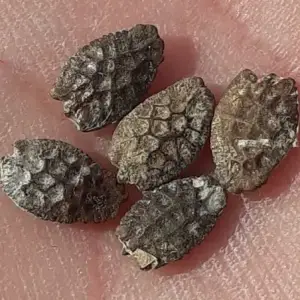
Seeds of the Passiflora alata are flat and arrow-shaped, measuring 7 millimeters long and grey in color.
They are dispersed inside the fruit amidst the aromatic pulp.
Antillean Gastronomy and Fruity Sweetness
The Barbadine offers a gelatinous pulp with a sweet and delicate flavor, ideal for making syrups and creamy jellies.
In the Antilles, this exotic fruit is particularly appreciated in fresh juice, mixed with condensed milk and a touch of nutmeg to create an iconic refreshing drink.
Culinary Versatility and Green Vegetable Use
The originality of the Barbadine lies in its thick flesh which, when still green, is cooked as a vegetable much like squash or chayote.
Boiled or prepared in a gratin, this flesh absorbs spices perfectly, thus offering a versatile culinary solution for diversifying stir-fried dishes in tropical cuisine.
It grows very well in well-drained, humus-rich soils.
A universal potting soil amended with compost or manure will be perfectly suitable to promote its good development.
This beautiful exotic vine requires full sun exposure.
The more light it receives, the more abundant its flowering and fruiting will be.
Native to tropical regions, this passion flower does not tolerate temperatures below -2°C.
It is hardy in areas where temperatures do not drop below 0°C.
In colder climates, it must be protected by mulching its base or cultivated in a pot to be brought inside before the winter period.
It requires regular watering during planting to keep the soil moist, but never with stagnant water.
During the growth period, a sustained supply of water promotes flowering.
I advise you to mulch its base to keep constant humidity during the summer.
This red-flowered passion flower is mainly propagated by seeds or cuttings.
Cutting under a cloche (at high humidity) in early summer allows for obtaining plants identical to the mother plant more quickly.
Your review appreciation cannot be sent
Report comment
Report sent
Your report cannot be sent
Write your review
Review sent
Your review cannot be sent

check_circle
check_circle


