


Reference: 1232


Linden also known as the Lime tree or Basswood is a tree from the Malvaceae family that grows relatively quickly. It can reach heights of 15 to 30 meters. It is native to Europe and North America, as well as Northern Asia. Originally, the linden was not an urban tree, although it is frequently encountered in cities today. It belongs to the deciduous forest ecosystems of the temperate regions across these three continents.
Its trunk is straight and can reach impressive diameters with age. In young specimens, the bark is gray and smooth, but it cracks and develops longitudinal furrows as it matures.
The wood is soft, light, and yellowish-white highly prized for carving because it is easily worked.
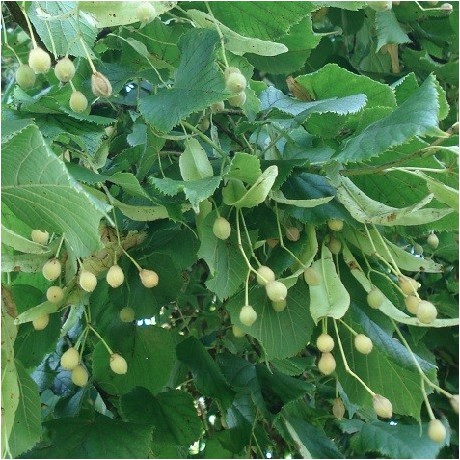
The leaves are deciduous, alternate, and feature a characteristic asymmetrical heart shape.
They are finely serrated along the edges and end in a point. Their color is a clear green on top, while the underside can be lighter.
The hermaphroditic flowers appear in early summer. They are grouped in small, drooping clusters of a yellowish-white or cream color.
A unique feature of the inflorescence is that it is attached by a long stalk to an elongated, pale green bract, which later facilitates the dispersal of the fruits by the wind. They release a very powerful, sweet fragrance.
Linden seeds from Tilia cordata are round, smooth, and light brown. Each fruit contains one or two seeds.
At maturity, the bract attached to the stalk acts like a glider wing, allowing the fruit to twirl and drift away from the mother tree as it falls, thus promoting the colonization of new areas.
Excellence of Wood: The Favourite of Master Sculptors
For cabinetmakers and artists, linden is a noble material of incomparable fineness.
Its extremely tight grain and homogenous texture make it the wood of choice for precision carving and woodturning.
Although its lightness and cream hue destine it mainly for indoor works, its resistance to splitting allows for works of surgical complexity, making each sapling a future reservoir of exceptional raw material.
Prestige Beekeeping and Menthol Honey
During its flowering season, the linden tree grown from Ethnoplants seeds transforms the garden into a sanctuary for biodiversity.
Its powerful fragrance irresistibly attracts bees, which then produce an amber honey with a unique aromatic profile, marked by a menthol freshness and a hint of bitterness on the finish.
Linden enjoys deep, cool, and fertile soils. It has a preference for humus-rich and slightly calcareous (lime-rich) lands, though it is quite tolerant.
However, it avoids overly acidic soils, excessively dry conditions, or permanently waterlogged ground.
It particularly thrives in full sun or partial shade. Bright exposure promotes steady growth and more abundant flowering.
Due to its significant size, it requires a clear location so its crown can flourish harmoniously.
This extremely hardy tree is perfectly adapted to temperate climates.
It easily withstands winter temperatures dropping to -20°C or -25°C.
It resists wind well but can suffer from prolonged heatwaves.
Its water needs are significant, especially during the first years after planting.
Copious and regular watering is essential to ensure successful establishment.
Once adult, the linden is self-sufficient thanks to its deep roots.
The most reliable method is layering or taking suckers from the base of the tree. Sowing is also possible.
It is frequently targeted by aphids, which secrete a sticky honeydew, often leading to the development of sooty mold (a black deposit) on the leaves.
It is also sensitive to mites, which form small red growths (galls) on the leaf blade—often unsightly but harmless to the tree.
This article was written by Julien on 07/15/2026.
Your review appreciation cannot be sent
Report comment
Report sent
Your report cannot be sent
Write your review
Review sent
Your review cannot be sent
Reference: 1175
Reference: 1236
check_circle
check_circle


